The remote is a magical wand. A flick of the wrist, a gentle press of a button, and poof – a portal opens. Instantly, you’re no longer folding laundry, but navigating the sterile, labyrinthine hallways of Lumon Industries, just like the innies on “Severance”. Another click, and suddenly you’re watching strangers confess their deepest secrets through a wall on “Love is Blind”. Give anyone a comfy couch, a questionable snack, and a login to one of the infinite number of streaming services, and they could achieve peak human laziness – it’s that easy. Effortless entertainment is practically a universal superpower.
That said, finding something to watch is often one of the most challenging parts of the day. So why, in this golden age of streaming…
…does choosing what to watch feel less like a leisurely stroll through a content garden and more like an endless “buffet” scroll of thumbnails and titles, none of which seem quite right?
In partnership with Two Cents Insights, a boutique research agency, Vox Media surveyed 2,000 adults 18+ to understand how consumers navigate the streaming universe and the nuances behind binge and scheduled watching. We found that searching and viewing habits vary greatly across generations, but there’s a universal need for trusted recommendations and post-show resources to navigate and enhance the streaming experience.
The Paradox of Choice and the Need for Better Curation
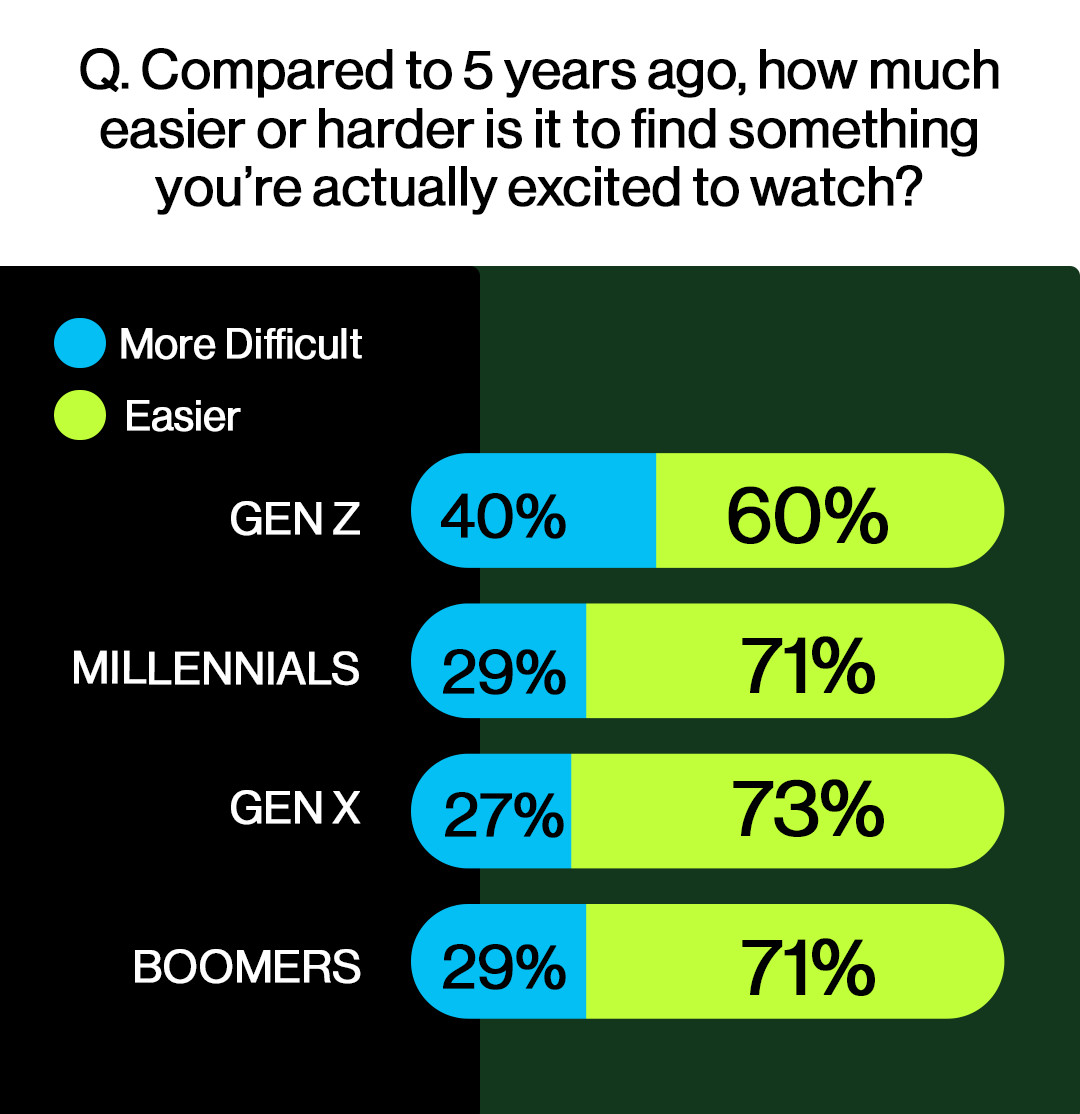
While the sheer volume of content available today makes discovering something to watch easier for many (70% overall say it’s easier than 5 years ago), a generational divide reveals a deeper issue. Younger viewers, particularly Gen Zers, are increasingly overwhelmed by the abundance of choices. A significant 40% of Gen Zers say it’s harder to find something they’re excited about, often resorting to less desirable options to avoid “scroll fatigue.” This highlights a crucial need for improved content discovery and curation on streaming platforms.
It’s not that viewers dislike choice, but rather that current tech often hinders the search. Gen Zers are more invested in the process, with over half willing to spend over 10 minutes searching. Boomers, on the other hand, are quicker to give up, with 70% dedicating less than 10 minutes to the search.
These challenges have driven viewers towards nostalgia and repeat viewing. A striking 70% of consumers (75% for Gen Zers) admit to re-watching familiar shows to avoid the overwhelm of browsing, and 68% sometimes settle for a less-than-ideal show to escape the endless scroll. This points to a critical challenge for streaming services: optimizing content discovery is no longer a luxury, but a necessity for retaining viewers, especially younger ones.
To Binge or Not to Binge? That is the Generational Question
In addition to choosing what to watch, viewers must answer the question of: to binge or not to binge? While Gen Zers have grown up in an era of scrolling feeds and on-demand content, Boomers have primarily experienced the linear nature of live TV and scheduled cable programming. These distinct experiences have shaped perspectives on binge watching, leading to notable differences in how often and how intensely each generation does it. Younger generations are more likely to identify as binge watchers and get sucked into an accidental binge. Boomers, on the other hand, are less likely to binge watch regularly and are more likely to view it as an occasional indulgence.
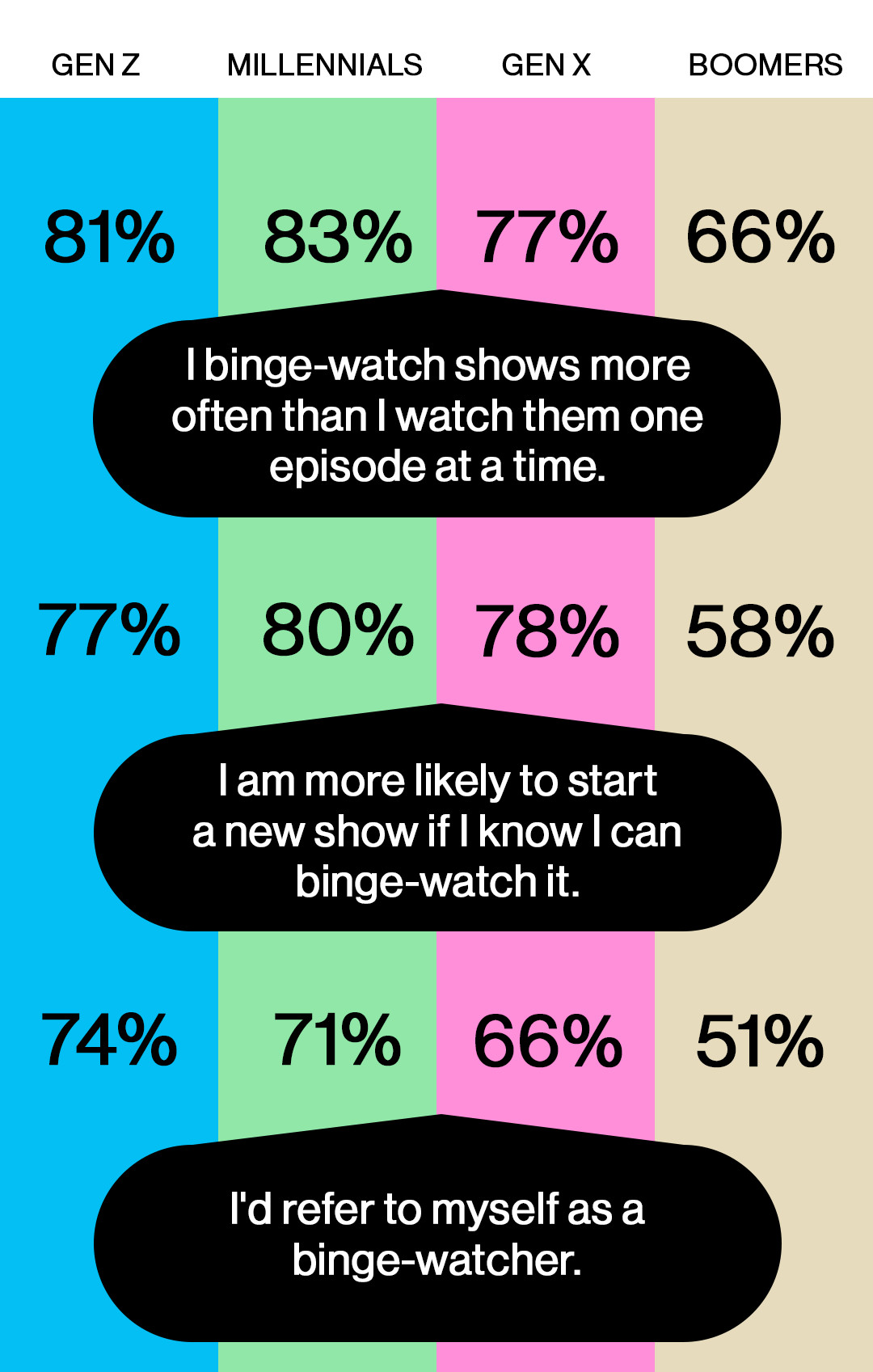
That said, all generations can succumb to the binge; 68% of consumers describe their binging as accidental or unplanned. It’s a universal truth: the accidental binge. That moment when a show grabs you, and you simply can’t look away. We’ve all experienced that delicious pull, that ‘just one more episode’ that turns into a marathon, and some viewers have taken their dedication to extraordinary heights. When asked the wildest thing they’ve done to keep binge-watching a show, viewers told us they:
Lie to loved ones: “Lied to my daughter about what time it is so she would go to bed earlier”
Rearrange their life: “I brought my laptop into the bathroom so I could keep watching and not miss anything”
Sacrifice their health & well-being: “Skipped taking a shower for a day”
At the end of the day, the fascinating truth is that we’re more than just “binge-watchers” or “scheduled watchers.” These labels oversimplify the complex ways we engage with content, and these viewing modes are simply tools we use depending on the circumstances. There’s no doubt that binge-watching is part of our routines; nearly 70% say they binge-watch a majority of the time. That said, 73% of viewers still tune in to new episodes within a few days of their release, indicating a strong desire to stay current with their favorite shows. This suggests a blend of viewing habits, where viewers might binge-watch older seasons or shows they discover later, while eagerly anticipating and watching new episodes as they air.

Seeking a Modern TV Guide Both Pre and Post-Watch
So what enables viewers to cut through the clutter and make informed viewing decisions? While algorithmic suggestions have their place, it’s the trusted voices – friends, family, and respected critics – that often carry the most weight. 66% of viewers say they watch a TV show/series because people are talking about it, and over 54% say online recommendations heavily influence what they watch. These percentages are even higher for younger consumers, which suggests that modern day watercooler conversations are happening before tune in.
In addition to seeking trusted recommendations on what to watch, viewers seek credible information once their viewing experience is complete. Younger viewers in particular don’t stop thinking about a show once it’s over. Instead, they have questions. What else was the cast in? What did critics say? Where was this filmed? What did my friends think?
After binge-watching a series, nearly 70% of viewers have read reviews or recaps, and nearly 3 in 4 have researched the cast and crew. Compared to older viewers, Gen Zers and Millennials are significantly more likely to do both of these. It’s clear that a show’s impact extends far beyond the final episode, sparking ongoing engagement and a desire for deeper understanding. In many ways, the shows that younger viewers stream serve as social currency allowing them to participate in cultural conversations.
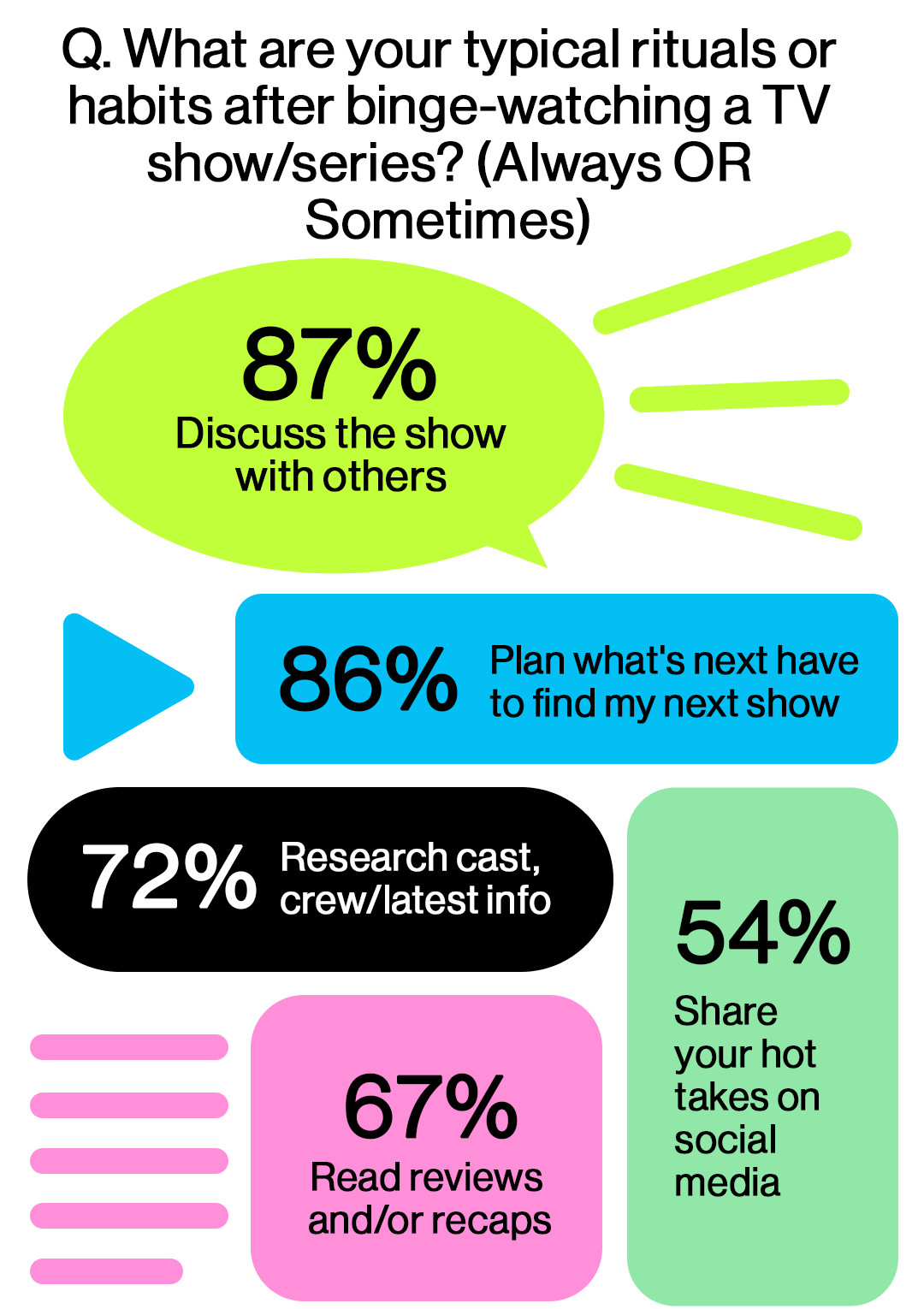
These insights into viewer behavior highlight significant opportunities for brands to connect with engaged audiences. By understanding the nuances of streaming habits across generations, marketers can develop targeted strategies that resonate with viewers before, during, and after their viewing experience.
Here are some strategies for brands to consider:
Create “The Moment” before the Moment: The pre-show time is key for watercooler chatter. Tap into this “influence” moment for younger generations with pre-release hype, commentary, trailers, and social/TikTok content. While they’re not multitasking during the show, they’re likely to come back to you for more once they’re done.
Be Their Post-Show Expert: After seeing a show, it’s not about what they as the viewer thinks, it’s what the experts think. Give them expert content that enables them to go deeper into their favorite shows. Who is the cast? Where are they now? What’s next? Leverage the halo effect of popular shows.
Reimagine Classic Content & Tap Into Nostalgia: There’s no such thing as old content when it comes to entertainment content. The shelf life is long and many shows are forever in vogue. Revisit old stories, characters, or series with fresh takes to make the old feel fresh again.
Targeting by Demos, not Viewing Modes: Labels like “binge-watcher” and “scheduled watcher” offer little nuance given they’re viewing modes, not identities. Talking to audiences with a tailored generational lens will better speak to how they view and experience the entire entertainment experience.
While these strategies are particularly effective for media and entertainment brands, the underlying principles of understanding viewer behavior before, during, and after watching are applicable across advertiser categories. Non-endemic brands, such as those in CPG or tech, can also leverage these strategies to connect with viewers in meaningful ways.
Choosing the right media partner to execute these strategies is crucial. Vulture, with its comprehensive coverage of TV and movies, can serve as a valuable platform for reaching audiences at every stage of their viewing journey. 78% of readers visit Vulture to learn about new movies and shows, while 66% come for TV recaps.

Partnering with Vulture allows brands to be present and relevant at every touchpoint of the streaming experience, from initial discovery to in-depth analysis.
Research Partner: This study was commissioned by the editorial desk at Vulture, with surveys from Two Cents Insights. The Vox Media Insights and Research team surveyed over 2,000 U.S. adults representing the U.S. population that watches content at least 3x a week on at least one of the streaming platforms (and must watch TV shows/episodic content). Two Cents Insights is a boutique research agency that partners with brands and digital platforms to transform research into actionable insights. Their expertise lies at the intersection of consumer needs and business goals, fueling differentiated go-to-market strategies and customer-centric product development.
Illustrator: Lauren O’Connell
Special thanks: Anusha Praturu, Neil Janowitz, & Edwin Wong